
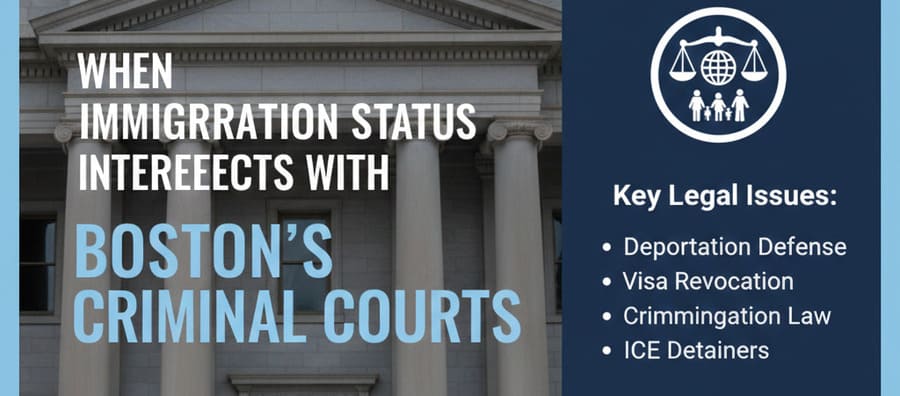
In Massachusetts, a criminal charge does not exist in isolation. For noncitizens, even a seemingly minor offense can trigger a second, far more complex legal process governed by federal immigration law. What begins as a routine arraignment in Boston Municipal Court can quietly evolve into detention by federal authorities, removal proceedings, or long-term immigration ineligibility.
For a legal-minded audience, the critical point is this: in the immigration context, the formal label attached to an offense often matters less than the technical federal consequences that flow from it. A disposition that appears manageable under Massachusetts law can produce outsized federal effects.
Parallel Legal Systems With Different Rules
Massachusetts criminal courts and the federal immigration system operate independently. A plea agreement reached in the Boston Municipal Court Department or Suffolk Superior Court may resolve the state case efficiently, but federal immigration authorities apply their own statutory definitions and analytical frameworks under the Immigration and Nationality Act (INA).
The U.S. Supreme Court recognized the gravity of this overlap in Padilla v. Kentucky, holding that criminal defense attorneys must advise noncitizen clients about the risk of deportation arising from guilty pleas. The Court acknowledged that removal is often intimately connected to the criminal process. Yet even after Padilla, the complexity remains. Immigration law employs specialized categories such as “conviction,” “crime involving moral turpitude,” and “aggravated felony,” none of which align neatly with Massachusetts criminal terminology.
The Federal Definition of a Conviction
One of the most common misunderstandings involves what constitutes a conviction. In Massachusetts practice, a continuance without a finding (CWOF) can feel like a favorable resolution. A defendant admits to sufficient facts, the case is continued, and if the conditions are satisfied, it is dismissed without a formal guilty finding.
Under federal immigration law, however, the definition of “conviction” is broader. If a person admits sufficient facts and a penalty or restraint—such as probation—is imposed, immigration authorities may treat the case as a conviction regardless of the ultimate dismissal under state law. The federal analysis focuses on whether there was an admission and some form of punishment, not on how Massachusetts labels the outcome.
This divergence can create lasting consequences. A CWOF for what appears to be a minor offense may still render someone removable or ineligible for certain forms of immigration relief.
Crimes Involving Moral Turpitude
Immigration law’s concept of a “crime involving moral turpitude” (CIMT) is notoriously opaque. The term does not appear in Massachusetts statutes, yet it plays a pivotal role in determining removability and admissibility. Offenses involving fraud, theft with intent to permanently deprive, or certain types of assault may fall into this category.
The analysis is categorical rather than factual. Immigration adjudicators generally compare the statutory elements of the Massachusetts offense to federal definitions instead of revisiting the specific conduct in the case. If the least serious conduct criminalized by the statute fits within the federal definition of a CIMT, the conviction may trigger immigration consequences.
A single CIMT committed within five years of admission, if the offense is punishable by a sentence of one year or more, can render a noncitizen removable. Multiple CIMTs can have similar consequences. These determinations often hinge on technical statutory interpretation rather than the perceived severity of the conduct.
Drug Offenses and Federal Consequences
Drug-related charges present particularly high stakes. Massachusetts has adopted relatively lenient policies in some contexts, especially with respect to small amounts of marijuana. Yet federal immigration law continues to treat most controlled substance convictions as grounds for removal.
There is a narrow exception for a single offense involving possession of 30 grams or less of marijuana for personal use. Outside that limited scenario, even a simple possession conviction can trigger deportation proceedings. More serious drug charges, including possession with intent to distribute or distribution offenses, may be classified as “aggravated felonies” under the INA.
The term “aggravated felony” is itself misleading. It encompasses a wide range of offenses, including some that Massachusetts classifies as misdemeanors. Once an offense is deemed an aggravated felony for immigration purposes, eligibility for many forms of relief from removal may disappear, and mandatory detention can follow.
Domestic Violence and Assault Allegations
Assault and battery charges are common in Boston’s criminal courts, particularly in domestic contexts. For noncitizens, these cases can implicate both the CIMT framework and specific federal removal grounds tied to domestic violence.
A conviction for a crime of domestic violence, defined federally as a crime of violence committed against a person with a qualifying domestic relationship, can independently trigger removability. Even when the underlying state charge seems relatively minor, the existence of a domestic relationship can elevate the immigration risk substantially.
Protective order violations carry their own dangers. A finding that a noncitizen violated a protection order in a manner involving threats or violence may create a separate basis for removal, independent of the underlying assault charge.
The One-Year Sentence Problem
Sentence length can be decisive in immigration analysis. Certain theft or fraud offenses become aggravated felonies if a sentence of one year or more is imposed, even if that sentence is suspended. In plea negotiations, the difference between a 365-day sentence and a 364-day sentence can determine whether an individual remains eligible for relief such as cancellation of removal.
This seemingly technical distinction underscores how immigration consequences often turn on precise statutory thresholds rather than on a judge’s subjective view of the offense. A single day in a sentence can alter the trajectory of a person’s immigration status permanently.
Enforcement and Detention Concerns
The intersection of Boston’s criminal courts and federal immigration enforcement extends beyond convictions. Immigration and Customs Enforcement may issue detainers for individuals encountered in the criminal system. Although Massachusetts has adopted policies limiting cooperation with civil immigration detainers absent judicial warrants, federal authorities retain independent enforcement authority.
A noncitizen who posts bail in a state case may still face transfer to federal custody. The timing of plea negotiations and case resolutions can influence exposure to immigration detention, adding another layer of complexity to strategic decision-making.
Long-Term Immigration Implications
Criminal dispositions can affect far more than immediate removability. They may impact eligibility for adjustment of status, naturalization, asylum, or other forms of relief. Lawful permanent residents with decades of residence can find their status jeopardized by a single conviction that fits within a federal removal category.
For individuals navigating this terrain, consultation with a Boston immigration lawyer who understands both federal removal law and Massachusetts criminal procedure can be essential. The overlap between these systems is highly technical, and once a conviction is entered, unwinding its immigration effects can be extraordinarily difficult.
A Dual Lens on Risk
When immigration status intersects with Boston’s criminal courts, every charge must be evaluated through two lenses. The first asks how the case will resolve under Massachusetts law. The second asks how federal immigration authorities will classify that resolution months or even years later.
What appears minor in state court can be transformative in immigration court. That reality demands careful statutory analysis, strategic coordination, and an appreciation that in the immigration context, there is rarely such a thing as a harmless plea.


