
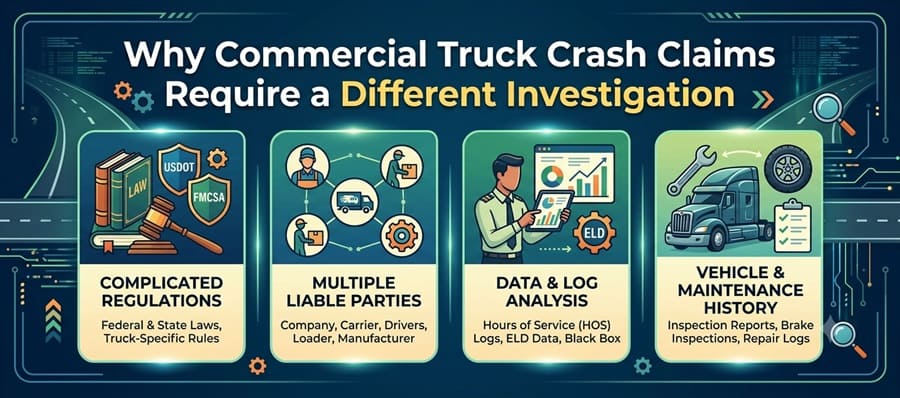
A collision involving a commercial truck may look like a larger version of an ordinary car accident, but the legal and factual issues are often much more complicated. Tractor-trailers, delivery trucks, dump trucks, and other commercial vehicles operate within a network of drivers, employers, contractors, maintenance providers, cargo companies, and insurers. When a serious crash occurs, determining what happened may require evidence from several of these parties.
Understanding why truck crash claims are different can help injured people avoid early mistakes and preserve information that may become important later.
More Than One Party May Be Responsible
In a typical two-car collision, the investigation often focuses primarily on the conduct of the drivers. A commercial truck crash may involve a much wider group of potentially responsible parties.
Depending on the circumstances, responsibility could extend to:
- The commercial driver
- The trucking company or motor carrier
- A company that hired or contracted with the carrier
- A maintenance or repair provider
- A cargo-loading company
- The manufacturer of a defective truck component
- Another driver whose actions contributed to the collision
For example, a driver may have caused a crash by speeding or following too closely. However, the trucking company may also have contributed if it failed to screen the driver properly, ignored a history of unsafe conduct, or placed unreasonable pressure on the driver to meet a delivery schedule. A maintenance provider could be involved if defective brakes or worn tires played a role.
Because liability can be shared, an investigation should look beyond the person who was behind the wheel.
Commercial Trucks Generate Unique Evidence
Truck crash investigations may involve records that do not exist in ordinary passenger-vehicle cases. These materials can help reconstruct the vehicle’s operation before the impact and reveal whether safety procedures were followed.
Potential evidence may include:
- Electronic logging device data
- Dispatch instructions and delivery schedules
- Driver qualification and training records
- Hours-of-service records
- Vehicle inspection reports
- Maintenance and repair histories
- Cargo manifests and loading records
- Data from onboard electronic systems
- Dash-camera or surveillance footage
- Mobile phone and communication records
This evidence may answer important questions. How fast was the truck traveling? Had the driver been on duty too long? Was a mechanical problem reported but not repaired? Was the cargo loaded or secured improperly? Did company communications encourage the driver to continue despite unsafe conditions?
Some records may be overwritten or disposed of through routine business practices. For that reason, it can be important to identify and request relevant evidence as early as possible.
Federal and State Safety Rules May Apply
Commercial trucking is subject to safety requirements that go beyond the traffic laws applying to everyday motorists. Depending on the vehicle and route, rules may address driver qualifications, hours of service, inspections, maintenance, cargo securement, drug and alcohol testing, and other operational matters.
A safety violation does not automatically resolve every question of fault. Still, proof that a driver or company failed to follow an applicable rule may provide important context when determining why the crash occurred.
The investigation should connect any alleged violation to the collision itself. A missing form may have little relevance, while ignored brake problems, excessive driving hours, or improperly secured cargo could be central to the cause of a wreck.
The Severity of the Injuries Changes the Evaluation
The size and weight of a commercial truck can result in severe injuries to occupants of smaller vehicles. A person may face emergency treatment, surgery, rehabilitation, lost income, and lasting physical limitations. Some injuries may affect the person’s ability to work or require future medical care.
Evaluating these losses involves more than adding the bills received immediately after the crash. A careful assessment may consider:
- Past and anticipated medical expenses
- Lost wages and reduced earning capacity
- Rehabilitation and assistive-care needs
- Property damage
- Pain, emotional distress, and loss of normal activities
- The long-term effect of permanent injuries
Accepting a settlement before the medical outlook is reasonably clear can create problems. Once a claim is finally resolved, an injured person generally cannot reopen it simply because the condition later proves more serious than expected.
Insurance Issues Can Be More Complicated
Commercial trucking operations may have multiple insurance policies, coverage layers, and contractual relationships. The driver, carrier, trailer owner, shipping company, or another business may have separate coverage. Insurers may disagree over which policy applies or who must defend a particular party.
An insurance representative may contact an injured person shortly after the collision and request a recorded statement, authorization, or quick settlement. Before providing broad access to medical information or signing a release, the person should understand what is being requested and how it could affect the claim.
The trucking company’s insurer also may begin investigating immediately. Its representatives may inspect the vehicles, obtain statements, review electronic data, and build a defense while the injured person is still receiving medical care.
Georgia’s Fault Rules Can Affect Recovery
Fault is not always assigned entirely to one party. A truck driver, trucking company, and another motorist may each be accused of contributing to the same crash. Insurers may also argue that the injured person shares some responsibility.
Because the allocation of fault can affect the amount a person may recover under Georgia law, evidence from the scene is especially important. Photographs, witness information, vehicle damage, roadway markings, police documentation, and available video can help clarify how the collision occurred.
People seeking legal guidance after a serious truck collision in Atlanta can also benefit from having the driver’s conduct, company records, insurance coverage, and potential long-term losses reviewed together rather than as separate issues.
Practical Steps After a Commercial Truck Crash
Safety and medical care should come first. If circumstances allow, the following steps may also help protect useful evidence:
- Report the crash and request emergency assistance when needed.
- Obtain medical evaluation promptly, even if some symptoms seem manageable at first.
- Photograph the vehicles, road conditions, debris, traffic signs, and visible injuries.
- Record the trucking company’s name, truck number, license plate, and insurance details.
- Collect contact information from witnesses.
- Keep copies of medical records, bills, receipts, wage information, and insurance correspondence.
- Avoid guessing about fault when speaking with insurers or posting details publicly.
- Do not authorize repairs or disposal of a seriously damaged vehicle before considering whether an inspection is needed.
No checklist can replace an investigation tailored to the facts. The type of truck, parties involved, severity of the injuries, and location of the crash may all change what evidence matters most.
A Complete Investigation Matters
Commercial truck crash claims are different because the cause of the collision may be spread across multiple people, companies, records, and safety obligations. Focusing only on the driver’s actions may overlook negligent maintenance, unsafe scheduling, improper loading, inadequate hiring practices, or defective equipment.
An early, organized investigation can help preserve evidence, identify potentially responsible parties, and document the full effect of the injuries. For anyone hurt in a serious truck collision, understanding these differences is an important first step toward making informed decisions.
This article is for general informational purposes only and does not constitute legal advice.