

Navigating the Administrative Process and Securing Workplace Discrimination Representation
For individuals facing workplace discrimination, understanding the administrative process is the foundational step toward seeking justice. Before an employee can file a lawsuit in federal court under most anti-discrimination statutes enforced by the EEOC, they must first file a Charge of Discrimination with the agency. This administrative prerequisite is designed to give the EEOC an opportunity to investigate the claim and attempt to resolve it through conciliation before litigation commences. Securing effective workplace discrimination representation is often crucial at this initial stage, as legal counsel can guide individuals through the complex filing requirements and deadlines.
Filing a Charge of Discrimination with the EEOC
A Charge of Discrimination is a sworn statement outlining the alleged discriminatory acts, including who was involved, what happened, and when it occurred. It serves as the official notification to the EEOC that an individual believes their employer has violated federal anti-discrimination laws.
The process typically begins with an online inquiry through the EEOC Public Portal, which allows individuals to submit information about their potential claim. Following this, an intake interview with an EEOC staff member is often scheduled. This interview is a critical opportunity for the individual to discuss their concerns and for the EEOC to assess the validity of the claim and determine the appropriate course of action. The EEOC emphasizes that these interviews are the best way to understand how to address employment discrimination concerns.
Strict time limits govern the filing of a Charge of Discrimination. Generally, an individual must file within 180 days from the date of the discriminatory act. However, this deadline is extended to 300 days if a state or local Fair Employment Practices Agency (FEPA) enforces a law prohibiting the same type of discrimination. It is imperative to file promptly, as missing these deadlines can permanently bar an individual from pursuing their claim. For situations where 60 days or fewer remain until the deadline, the EEOC Public Portal provides expedited filing directions.
Federal government employees and applicants follow a different complaint procedure, typically involving an EEO counselor within their agency before filing a formal complaint with the EEOC. As of July 2026, the EEOC continues its enforcement efforts across various sectors, adapting to evolving workplace dynamics and legal precedents.
EEOC vs. FEPA: Understanding Dual-Filing Systems
The landscape of anti-discrimination law is not solely federal; many states and local jurisdictions have their own Fair Employment Practices Agencies (FEPAs) that enforce state or local anti-discrimination laws. These FEPAs often have broader protections or lower employer thresholds than federal laws.
A key feature of this system is “dual-filing.” If a charge is filed with a state or local FEPA, it is automatically dual-filed with the EEOC if federal laws apply. This means an individual does not need to file separately with both agencies. This system ensures administrative efficiency and allows claims to be processed under both federal and relevant state or local statutes simultaneously. For instance, in California, the California Civil Rights Department (CRD) acts as a FEPA, and a charge filed with the CRD would typically be dual-filed with the EEOC. This coordination is beneficial as it covers both federal and state claims without requiring redundant paperwork.
The interaction between federal and state agencies provides a comprehensive safety net for employees. It’s important to be aware that state laws may offer different or additional protections than federal laws. For example, some state laws might cover smaller employers or protect additional characteristics not explicitly covered by federal statutes.
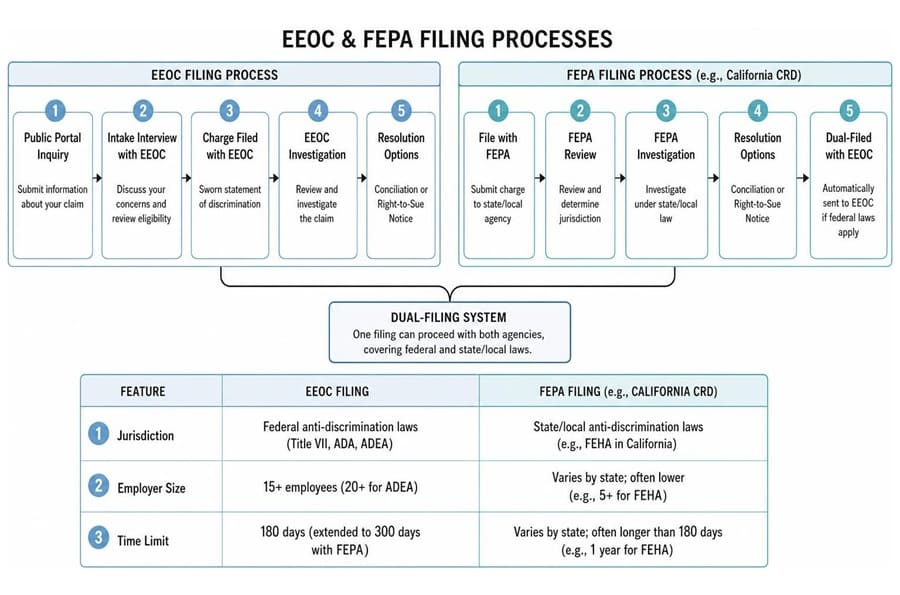
Feature EEOC Filing FEPA Filing (e.g., California CRD)
- Jurisdiction: Federal anti-discrimination laws (Title VII, ADA, ADEA) State/local anti-discrimination laws (e.g., FEHA in California)
- Employer Size: 15+ employees (20+ for ADEA) Varies by state; often lower (e.g., 5+ for FEHA)
- Time Limit: 180 days (extended to 300 days with FEPA) Varies by state; often longer than 180 days (e.g., 1 year for FEHA)
- Dual-Filing: Automatically dual-filed with FEPA if applicable Automatically dual-filed with EEOC if federal laws apply
- Laws Enforced: Title VII, ADA, ADEA, GINA, EPA, PWFA Broader scope possible, additional protected classes
- Prerequisite for Lawsuit: Mandatory for most federal lawsuits Often mandatory for state lawsuits
The Legal Battleground of Advocacy Discrimination under Title VII
Title VII of the Civil Rights Act of 1964, codified at 42 U.S.C. § 2000e-2, prohibits discrimination based on race, color, religion, sex, and national origin. While its primary purpose is to protect individuals directly targeted by discrimination, a more nuanced area of law has emerged: “advocacy discrimination.” This theory addresses situations where an employee faces adverse action not because of their own protected characteristic, but because they advocated on behalf of a coworker or group with protected characteristics. The legal landscape surrounding this theory is complex, marked by a significant circuit split and ongoing judicial interpretation.
The Sixth Circuit and the Origins of Workplace Discrimination Representation for Advocates
The concept of advocacy discrimination gained significant traction with the Sixth Circuit’s ruling in Johnson v. University of Cincinnati in 2000. In this landmark case, the plaintiff, a Vice President of Human Resources, alleged he was fired for advocating for the university’s compliance with affirmative action policies and fair hiring practices for women and minorities. He argued that his termination was a result of his efforts to ensure the university adhered to equal employment opportunity principles.
The Sixth Circuit recognized that Title VII could protect an employee who advocates for others, even if the advocate themselves does not share the protected characteristic of the group they are defending. The court reasoned that the employer’s animus was directed at the advocacy of civil rights, which was inextricably linked to the protected characteristics of the beneficiaries of that advocacy. Essentially, the protected characteristics of the third party were “imputed” to the advocate-plaintiff, allowing them to establish a prima facie case of discrimination. This ruling provided a crucial legal pathway for employees who step up to challenge discrimination on behalf of their colleagues, establishing a form of workplace discrimination representation for these “advocate-plaintiffs.”
The First Circuit Split: Frith v. Whole Foods Market
Despite the Sixth Circuit’s precedent, the legal recognition of advocacy discrimination is far from universal. A significant circuit split emerged with the First Circuit’s 2022 decision in Frith v. Whole Foods Market. This case involved employees who were disciplined or terminated for wearing face masks with “Black Lives Matter” slogans during the COVID-19 pandemic, in solidarity with their Black coworkers. They argued that their employer’s actions constituted advocacy discrimination.
However, the First Circuit rejected this claim, ruling that Title VII does not protect employees who advocate for others based on protected characteristics unless the advocate themselves possesses that characteristic or the advocacy falls under the statute’s retaliation clause. The court explicitly stated that Bostock v. Clayton County (which we’ll discuss next) did not expand Title VII to cover third-party advocacy. This decision directly contradicted the Sixth Circuit’s reasoning in Johnson, creating a clear disagreement among federal appellate courts on the scope of Title VII’s protections for advocates. The Frith ruling highlights the ongoing challenge for employees who engage in workplace advocacy, particularly concerning issues of racial justice and other protected characteristics.
The Impact of Bostock v. Clayton County on Advocacy Claims
The Supreme Court’s 2020 decision in Bostock v. Clayton County significantly clarified the scope of “sex” discrimination under Title VII, ruling that it includes discrimination based on sexual orientation and gender identity. The Court emphasized a “but-for” causation standard, meaning that if an employer relies on an employee’s sex in taking an adverse action, even if other factors are involved, discrimination has occurred.
The question then arose: how does Bostock impact advocacy discrimination claims? The First Circuit in Frith interpreted Bostock as foreclosing such claims, arguing that Bostock focused on the individual plaintiff’s own protected characteristic as a “but-for” cause, not on their advocacy for others. However, many legal scholars argue that this interpretation misapplies Bostock. They contend that the Supreme Court in Bostock never addressed the specific issue of third-party advocacy. Instead, Bostock primarily focused on the direct relationship between an individual’s sex and the adverse employment action.
The debate centers on the plain language of Title VII (42 U.S.C. § 2000e-2). Does it protect employees who are discriminated against for advocating on behalf of coworkers with protected characteristics? Proponents of advocacy discrimination argue that animus against such advocacy is functionally equivalent to animus against the protected characteristic itself, making it a form of discrimination “because of” that characteristic. Opponents argue that Title VII is designed to protect individuals based on their own protected traits, not their association with or advocacy for others. This ongoing disagreement underscores the need for further judicial clarification or legislative action to provide consistent protection for advocate-plaintiffs.
Alternative Legal Frameworks and Practical Implications for Employers
Given the uncertainty surrounding direct advocacy discrimination claims, particularly in circuits that do not recognize the Johnson theory, employees and their legal representatives often explore alternative legal frameworks. These alternative approaches can provide protection for third-party advocates and are crucial in cases that might also involve wrongful termination and harassment cases. Employers, in turn, must be aware of these broader protections to ensure compliance and mitigate legal risks.
Protecting Third-Party Advocates through Retaliation and Associational Claims
One of the most robust alternative frameworks is the retaliation claim under Title VII. Federal law explicitly prohibits employers from retaliating against an employee for opposing any practice made unlawful by Title VII, or for participating in an investigation, proceeding, or hearing under Title VII. This “opposition clause” protects employees who speak out against discrimination, even if their advocacy does not directly involve their own protected characteristic. For example, if an employee reports racial discrimination against a coworker and is subsequently fired, they may have a strong retaliation claim, regardless of their own race.
Another important framework is associational discrimination. This theory posits that discrimination against an employee because of their association with an individual or group of a protected class is also prohibited. For instance, if an employer discriminates against a white employee because of their marriage to a Black individual, or their close association with minority colleagues, this could constitute associational discrimination based on race. While distinct from advocacy discrimination, it covers situations where an employee is penalized due to their relationships with protected individuals.
Finally, the “zone of interests” test is a principle used to determine whether a plaintiff has standing to sue under a particular statute. While primarily a standing doctrine, it can be relevant in cases where a bystander intervenes against discrimination. If an employee’s advocacy is seen as falling within the “zone of interests” Title VII was designed to protect, it could bolster their standing to bring a claim, even if a direct advocacy discrimination theory isn’t explicitly recognized in their jurisdiction. These alternative avenues are often pursued in conjunction, offering a multi-faceted approach to protecting employees who stand up against discrimination.
These alternative avenues are often pursued in conjunction, offering a multi-faceted approach to protecting employees who stand up against discrimination. Beyond identifying the right legal theory, employees also need to weigh their practical options after workplace discrimination occurs — whether that means filing an internal complaint, pursuing an EEOC charge, negotiating a resolution directly with an employer, or preparing for litigation. The right path often depends on the strength of the available evidence, the employee’s goals, and how quickly action is needed to preserve deadlines.
The Role of Modern Social Movements in Workplace Discrimination Representation
Current social movements have significantly amplified the relevance and urgency of protecting advocate-plaintiffs in the workplace. Movements like Black Lives Matter, #MeToo, and LGBTQ+ rights have inspired a new wave of employee activism, with workers increasingly vocal about issues of equity, inclusion, and justice. In July 2026, these movements continue to shape corporate policies and employee expectations.
This heightened awareness and willingness to advocate can lead to increased instances where employees speak out against perceived discrimination or unfair practices. For example, employees might push for more inclusive corporate DEI (Diversity, Equity, and Inclusion) initiatives, challenge discriminatory dress codes (as seen in Frith), or demand accountability for harassment.
However, as the research indicates, there’s a growing tension. While DEI programs aim to foster inclusivity, there’s also a legal and political pushback, with some arguing that certain DEI practices can lead to “reverse discrimination.” The EEOC itself has issued guidance clarifying that DEI initiatives must comply with Title VII and not result in discrimination against any group. This creates a complex environment where employees advocating for DEI might find themselves in the crosshairs, making the legal protections for such advocacy more critical than ever. The rise of employee activism means that employers are more likely to encounter situations where an employee’s advocacy, rather than their own protected characteristic, becomes the catalyst for adverse employment action, underscoring the ongoing need for robust workplace discrimination representation.
Frequently Asked Questions about Workplace Discrimination
Navigating workplace discrimination claims can be daunting. Here, we address some common questions to help clarify the process and your rights.
What is the time limit to file a Charge of Discrimination with the EEOC?
As of July 2026, the primary time limit for filing a Charge of Discrimination with the EEOC is 180 calendar days from the date of the alleged discriminatory act. However, this deadline is extended to 300 calendar days if the discrimination is also prohibited by a state or local anti-discrimination law, and there is a state or local agency (FEPA) with the authority to grant or seek relief. It is crucial to remember that these are strict deadlines, and missing them can preclude you from pursuing your claim. We always advise filing as soon as possible and consulting with an attorney or the EEOC directly to confirm the applicable deadline for your specific situation.
Can an employee be fired for advocating on behalf of a coworker’s civil rights?
While the legal landscape is complex and varies by jurisdiction, generally, an employee is protected from retaliation for “opposing” practices made unlawful by Title VII. This includes advocating on behalf of a coworker’s civil rights. If an employee is fired, demoted, or subjected to other adverse actions because they spoke out against discrimination or participated in an investigation, they may have a strong retaliation claim.
However, as discussed with the circuit split on advocacy discrimination, whether the act of advocacy itself (separate from retaliation) is a protected characteristic for the advocate depends on the court. Regardless, employers should be extremely cautious when taking action against an employee who has engaged in protected opposition, as such actions can lead to significant legal remedies for the employee.
How does the EEOC’s case selection process affect private litigation?
The EEOC, despite its critical role, has limited resources and cannot litigate every case where discrimination is found. Its Office of General Counsel strategically selects cases for litigation based on factors such as the nature of the violation, the issues presented, and the potential wider impact of the lawsuit on combating workplace discrimination. This means that if the EEOC declines to litigate an individual’s case, it does not necessarily mean the claim lacks merit.
When the EEOC decides not to pursue a case, it issues a “Notice of Right to Sue” letter. This letter is a crucial document, as it allows the individual to file a private lawsuit in federal court. Therefore, the EEOC’s case selection process directly impacts private litigation by serving as a gatekeeper, and often, by providing the necessary administrative step before private attorneys can take a case to court. For many victims of discrimination, private legal counsel becomes essential to pursue justice when the EEOC does not litigate on their behalf.
Conclusion
The journey through workplace discrimination claims, from the initial Charge of Discrimination to potential litigation, is intricate and constantly evolving. As of July 2026, employees continue to navigate a legal landscape shaped by foundational statutes like Title VII, landmark court decisions, and the dynamic influence of social movements.
Understanding the administrative prerequisites, such as filing with the EEOC or a FEPA, is paramount. These steps, while seemingly bureaucratic, are vital gateways to justice. The emerging theories of advocacy discrimination, though subject to circuit splits, highlight a growing recognition of the courage displayed by employees who stand up for others. Even where direct advocacy claims face hurdles, alternative frameworks like retaliation and associational discrimination offer crucial protections for those who champion civil rights in the workplace.
Achieving workplace equity and systemic reform requires not only robust legal frameworks but also informed and empowered employees. Legal advocacy plays a pivotal role in ensuring that individuals receive fair treatment and that employers are held accountable. By understanding these rights and processes, we can collectively work towards a workplace where discrimination is not tolerated, and all individuals have the opportunity to thrive free from prejudice.


