

Key Takeaways
- Binding arbitration results in a legally binding outcome, enforceable by courts, with limited grounds for appeal.
- Non-binding arbitration yields an advisory opinion, affording parties the option to proceed with further legal remedies if the decision is unsatisfactory.
- The choice between them influences your legal rights, up-front costs, and the long-term implications for dispute resolution.
Arbitration is an increasingly popular alternative to court litigation, providing individuals and businesses with a practical and efficient way to resolve disputes. Among the various arbitration methods available, understanding the distinction between binding and non binding arbitration is crucial for anyone considering their dispute resolution options. The selection between these two approaches can have significant implications on finality, cost, and control over outcomes—making it crucial for parties to navigate the process knowledgeably and thoughtfully.
The significance of arbitration in today’s dispute resolution landscape cannot be overstated. Whether stipulated in a commercial contract or agreed upon after a dispute arises, arbitration processes provide streamlined and confidential alternatives to traditional courtroom battles. However, the enforceability and procedural implications can vary greatly depending on whether the arbitration is binding or non-binding, which means choosing the right method is fundamental to protecting your interests and objectives.
In both business and personal disputes, understanding the role that an arbitrator plays—and the authority they wield—can significantly impact how satisfied parties are with both the process and the outcome. Each process suits different needs: binding arbitration lends finality and efficiency, whereas non-binding arbitration serves as a flexible, advisory option that can facilitate negotiation or pave the way for further legal action.
Understanding Arbitration
Arbitration is a process where disputing parties agree to submit their disagreement to one or more neutral third parties (arbitrators) who review evidence and arguments before reaching a decision. This approach is favored for its private setting, flexible procedures, and potential to minimize lengthy litigation. Arbitration typically operates outside the public eye and often ensures both speed and cost efficiency compared to traditional courts.
Arbitrators are typically experts in law, the relevant industry, or dispute resolution, and their involvement brings neutrality to heated or complex cases. Arbitration clauses can be found in many commercial, consumer, and employment agreements, serving as a preferred method for dispute resolution and reinforcing their value in modern legal landscapes.
Binding Arbitration
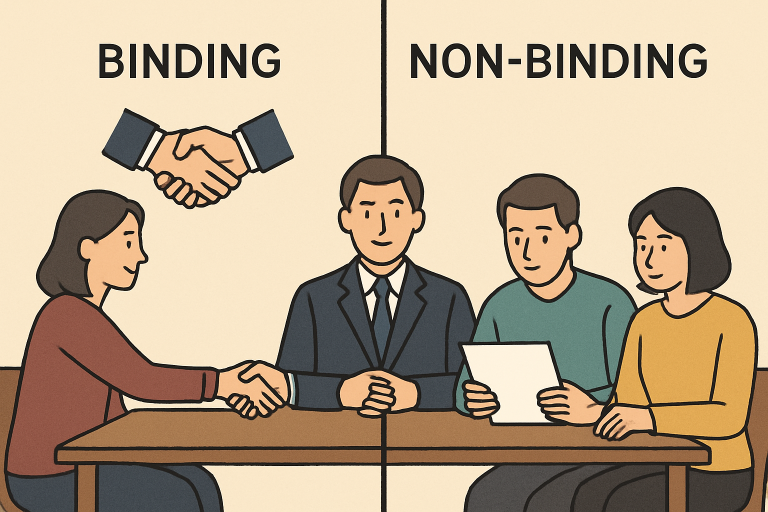
Binding arbitration is a process in which the decision rendered by the arbitrator is legally conclusive and directly enforceable. Once parties agree to binding arbitration, they accept that the ruling will carry the same weight as a court judgment. In most cases, opportunities for appeal are strictly limited to instances involving egregious misconduct, fraud, or procedural irregularities.
This method is regularly stipulated in many types of contracts, enabling parties to avoid the resource-intensive nature of lawsuits. Once a binding arbitration decision is delivered, the case is closed, and parties must comply with the outcome, streamlining dispute resolution and providing a sense of closure. This form of arbitration is ideal where parties desire certainty and a rapid conclusion, particularly in commercial settings where time and confidentiality are at a premium.
Non-Binding Arbitration
Non-binding arbitration, by contrast, is advisory rather than compulsory. The arbitrator’s decision serves as a recommendation, which parties can choose to accept or reject. If any side is dissatisfied, they retain the right to pursue litigation or other dispute resolution methods. Non-binding arbitration is often selected as a preliminary measure, allowing for negotiation and clarification of key issues without the risk of being permanently locked into the result.
This method encourages parties to assess their case’s strengths and weaknesses before incurring the costs and risks of a full trial. It also provides a neutral basis for settlement discussions. In areas where cooperation or long-term relationships matter, parties may value the flexibility and open dialogue afforded by non-binding arbitration.
Key Differences Between Binding and Non-Binding Arbitration
Arbitration Comparison: Binding arbitration yields a final and legally enforceable decision, whereas non-binding arbitration offers an advisory ruling that is not legally binding. The right to appeal is limited in binding arbitration, typically only in cases of fraud or misconduct. In contrast, non-binding arbitration allows for full rights to pursue litigation or other remedies. In terms of time and cost, binding arbitration is generally quicker and less expensive than litigation. In contrast, non-binding arbitration can be cost-effective initially but may lead to additional legal proceedings. Finally, control over the outcome differs: in binding arbitration, parties must accept the arbitrator’s decision, while in non-binding arbitration, parties have greater control and can choose to accept or reject the recommendation.
Pros and Cons of Each Method
Binding Arbitration
- Pros:
- Finality and enforceability of the decision
- Typically faster and less costly than court litigation
- Confidentiality of proceedings
- Cons:
- Limited avenues for appeal
- Potential for perceived unfairness if the arbitrator’s decision is unfavorable
Non-Binding Arbitration
- Pros:
- Flexibility to accept or reject the decision
- Opportunity to test arguments and evidence before a neutral party
- Can facilitate settlement negotiations
- Cons:
- May not resolve the dispute, leading to additional legal action
- Potential for increased costs and time if litigation follows
Choosing the Right Method for Your Dispute
Selecting between binding and non-binding arbitration should start with assessing the nature of your dispute, your goals, and your willingness to accept an arbitrator’s decision. Binding arbitration is well-suited for parties who need a definitive, enforceable resolution done efficiently. Non-binding arbitration, on the other hand, is ideal for those seeking a “trial run” or preserving full legal rights for later litigation.
Consider the complexity of your issue, your relationship with the opposing party, and the potential impact of an unenforceable or unfavorable outcome. Consulting an attorney with experience in alternative dispute resolution can help clarify which method aligns with your strategic goals and values.
Final Thoughts
A thorough understanding of the differences between binding and non-binding arbitration can empower parties to select the most effective and strategic method for dispute resolution. The decision to pursue one over the other impacts everything from cost and speed to enforceability and flexibility. Taking the time to weigh these considerations—ideally with the guidance of a professional lawyer—will ensure the process supports your best interests and leads to the most favorable resolution possible.