
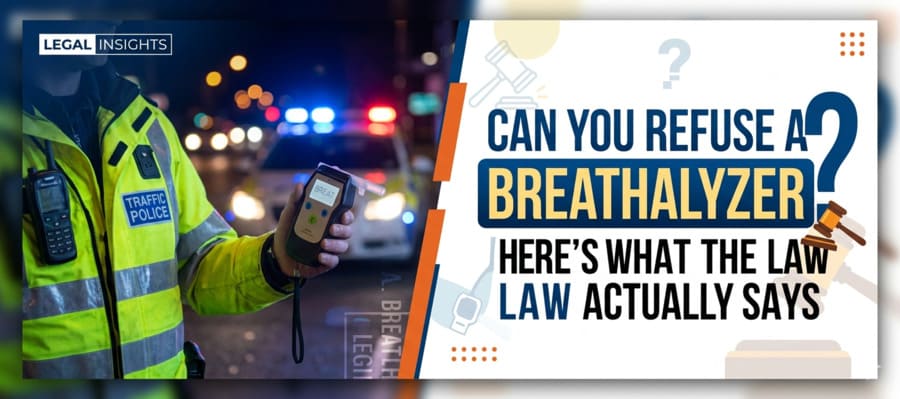
Many drivers assume they can simply refuse a breathalyzer test and avoid a DUI. In Maryland, that assumption can cost you your license almost immediately. While you technically can refuse certain tests, doing so triggers automatic penalties under the state’s implied consent law.
What you decide in that moment, whether to blow into the machine or not, can carry serious consequences either way.
What Is Implied Consent in Maryland?
Under Maryland’s implied consent law, anyone who drives on public roads is considered to have already agreed to chemical testing if they are lawfully arrested for DUI. That agreement covers breath, blood, and urine tests.
This rule does not apply during the initial traffic stop. An officer cannot compel you to take a breath test simply because you were pulled over. Implied consent is triggered only after a lawful DUI arrest.
Once that arrest occurs, however, refusing an evidentiary chemical test results in automatic administrative penalties imposed by the Maryland Motor Vehicle Administration. Those penalties move forward independently of any criminal DUI charges.
Breathalyzer vs. Preliminary Breath Test: These Are Not the Same Thing
This is where many drivers get confused.
There are two different types of breath tests in Maryland:
1. The Preliminary Breath Test (PBT)
This is the small handheld device officers may ask you to blow into on the roadside before an arrest. The PBT helps officers decide whether they have probable cause to make an arrest.
The PBT is not covered by implied consent.
You can refuse the roadside PBT without triggering the automatic license suspension that applies to post-arrest testing. However, refusal can still be mentioned in court as part of the officer’s observations. The PBT result itself is generally not admissible to prove guilt at trial, but it may be used to establish probable cause for the arrest.
2. The Evidentiary Breath Test
This test is usually administered at the police station after you are formally arrested. It is more sophisticated and designed to produce admissible evidence of your blood alcohol concentration.
This is the test that implied consent applies to. Refusing this test triggers formal consequences under Maryland law.
Understanding the difference between these two tests can significantly affect your situation.
What Happens If You Refuse the Breathalyzer in Maryland?
If you refuse the evidentiary breath test after a lawful arrest, Maryland imposes automatic administrative penalties.
For a first refusal:
- A 270-day license suspension
- A mandatory 45-day hard suspension with no driving privileges
- Eligibility for the ignition interlock program instead of serving the full suspension
By comparison, failing the test with a BAC of 0.08 or higher typically results in a 180-day suspension for a first offense.
The Motor Vehicle Administration handles this suspension separately from your criminal DUI case. Even if your DUI charges are reduced or dismissed, the administrative suspension can still proceed unless properly challenged.
Refusal can also be used in court. Prosecutors may argue that refusing the test shows “consciousness of guilt,” meaning you refused because you believed you would fail. Judges are allowed to consider that argument.
It is also important to understand that you can still be charged and convicted of DUI without a breath test result. Officers may rely on:
- Field sobriety tests
- Officer observations
- Body camera footage
- Witness statements
- Accident evidence
A breath test is powerful evidence, but it is not the only type of evidence.
Are There Situations Where Refusal Makes Sense?
There is no universal answer.
Some defense attorneys point out that without a BAC reading, the prosecution loses one of its strongest pieces of evidence. A DUI case without chemical results may rely more heavily on subjective observations.
At the same time, the penalties for refusal are steeper than for failing the test. The automatic 270-day suspension is significant. The refusal itself also becomes evidence in court.
Other factors may influence the decision, including:
- Prior DUI history
- Whether an accident occurred
- Whether injuries were involved
- Whether drugs, not alcohol, are suspected
This is why the decision can be highly fact-specific. A strategy that might benefit one person could seriously harm another.
An experienced Annapolis DUI lawyer can evaluate the total picture, including both the criminal case and the MVA consequences, before advising on long-term strategy.
What About Blood Tests in Maryland?
Breath tests are not the only form of chemical testing. In certain situations, officers may seek a warrant for a blood draw, even after a breath test refusal. This is more common in cases involving:
- Suspected drug impairment
- Serious injury accidents
- Fatal crashes
If police obtain a warrant, they can legally require a blood sample despite your refusal.
Maryland law has evolved in response to Supreme Court decisions regarding warrant requirements. In many situations today, a warrant is required for a nonconsensual blood draw unless specific exceptions apply.
Refusing a breath test does not always prevent the state from obtaining chemical evidence.
What Should You Do If You’re Pulled Over in Maryland?
Moments during a DUI stop move quickly. Emotions run high, and decisions feel urgent. Staying calm can make a meaningful difference.
Keep a few principles in mind:
- Remain polite and respectful
- Provide your license and registration when asked
- You are not required to answer investigative questions
- Do not argue roadside legal issues with the officer
If you are arrested, you will be presented with paperwork explaining your implied consent rights and the potential penalties. The officer may ask you to decide quickly, but that decision carries immediate legal consequences.
Protect Your License and Your Future
A DUI arrest in Maryland sets two processes in motion: a criminal case and an administrative license case. Whether you refused a test or provided one, you have limited time to request a hearing to challenge a suspension.
If you are facing DUI charges or a license suspension in Maryland, speak with a qualified defense attorney as soon as possible. Early action can preserve your right to drive and shape the direction of your case.