
When Business Partners Can’t Agree: A Litigator’s Guide to Partnership Dissolution and Forced Buyouts
Every partnership dispute I have handled started the same way: two people who trusted each other completely, and then didn’t. It rarely begins with whatever issue eventually shows up in the caption of a lawsuit. More often it starts with something smaller: a disagreement over money, direction, or workload that neither partner addresses directly, until resentment reaches a boiling point.
For the small business owners I represent, the moment a disagreement turns into a partnership dissolution, or a forced buyout is one of the most disorienting experiences they will go through professionally. The business they built together is suddenly in dispute, and the partner they trusted is now, the adversary. Understanding the legal mechanics before that moment arrives changes how it plays out and often determines whether the business survives it.
How Partnership Disputes Actually Start
Partnership breakdowns rarely come out of nowhere. In my experience, they tend to follow a handful of recognizable patterns:
- One partner contributes significantly more time, capital, or clients than the other, and the imbalance is never formally addressed.
- A disagreement over spending, hiring, or direction turns into a stalemate.
- One partner wants to exit or retire, and the remaining partner isn’t prepared, financially or emotionally, to let them go.
- Trust breaks down after a mistake or a suspicion that one partner is self-dealing.
- A partner becomes incapacitated or passes away, and the agreement doesn’t address what happens next.
None of these require bad faith. But each can escalate quickly once a partner consults a lawyer, and understanding your options early gives you far more control over the outcome.
Your Legal Options When a Partnership Breaks Down
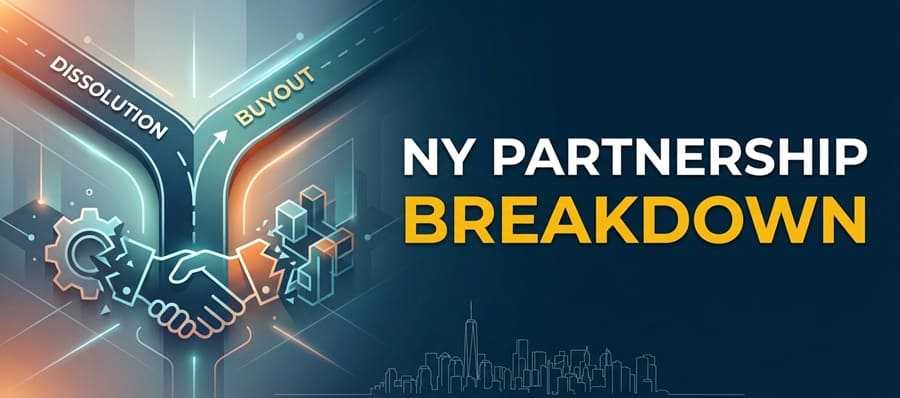
When partners can no longer work together, New York law generally offers two paths: winding the business down entirely through dissolution or restructuring ownership through a buyout that lets the business continue.
Start With the Governing Agreement
The first document I ask for in these matters is the partnership agreement, operating agreement, or shareholder agreement, whichever governs the entity. Most well-drafted agreements already specify how an exit or buyout is supposed to work: valuation methods, notice periods, and how any dispute over the process gets resolved. When the agreement is silent or was never properly executed, the parties fall back on New York’s default statutory rules, and that is where litigation risk increases.
Voluntary and Judicial Dissolution
For general partnerships, New York Partnership Law § 63 allows a court to decree dissolution on a partner’s application when a partner’s conduct makes it no longer reasonably practicable to carry on the business together, or when other circumstances render dissolution equitable.
For LLCs, New York Limited Liability Company Law § 702 uses similar language: a member can petition for dissolution when it is not reasonably practicable to carry on the business in conformity with the operating agreement. Courts read that standard narrowly. Simple friction between partners usually isn’t enough; the petitioner typically has to show the business’s stated purpose can no longer be achieved.
Full dissolution ends the entity. Assets are liquidated, debts are paid, and whatever remains is distributed among the partners. For an otherwise healthy business, that outcome is often more destructive than either partner wants, which is why a buyout is frequently the better path.
The Forced Buyout Alternative
Rather than winding down the business, one partner can be bought out while the business continues under the remaining partner or partners. This can happen voluntarily, through negotiation, or it can be compelled, either because the governing agreement includes a buy-sell provision, or because a court treats a buyout as a fairer alternative to liquidation.
What a Forced Buyout Actually Looks Like in Practice
Clients are often surprised how much a buyout dispute comes down to one question: what is the departing partner’s share actually worth? A few issues tend to dominate that conversation:
- Valuation method: book value, fair market value, and formula-based approaches can produce very different numbers for the same business.
- Marketability discounts: courts and appraisers sometimes reduce payouts for a minority or non-marketable interest, though New York law limits when this applies.
- Access to records: a partner being bought out is entitled to the company’s financial information, and disputes over access are common.
- Funding: lump sum versus an installment note, and whether insurance or a personal guarantee secures the payments.
Because the numbers rarely agree on their own, most buyouts involve dueling valuations before they involve dueling lawyers. Getting a qualified, independent appraiser involved early, rather than relying on internal bookkeeping alone, is usually the most useful step a partner can take.
Steps to Protect Your Business Before a Dispute Escalates
The strongest position in any partnership dispute belongs to the owner who prepared for one before it happened. Litigation is rarely the first or best tool; mediation and arbitration can often resolve business conflicts faster, more privately, and at lower cost, but only if your governing documents point that way from the start. A few practical steps make a real difference:
- Put a buy-sell provision in writing, with a defined valuation method, before you need one.
- Specify how disagreements get resolved: mediation, arbitration, or litigation, and in what forum.
- Keep clean, current financial records that both partners can access without a fight.
- Document roles, responsibilities, and capital contributions in writing.
- Revisit the agreement periodically; the arrangement that made sense at formation rarely still fits five years later.
When to Bring in a Litigation Attorney
Not every disagreement needs a lawyer immediately. But there are specific moments where getting one involved early will help protect your stake in the company:
- A partner has threatened to leave, dissolve the business, or force a buyout.
- You’ve been excluded from financial records, decision-making, or the premises.
- You’re being asked to sign a buyout or separation agreement.
- You believe the business itself, not just the relationship, is at risk.
In nearly every one of these situations, the partner who acts early, securing records, understanding their rights, and getting an accurate valuation, ends up in a materially better position than the one who waits until the dispute is already in court.
The Bottom Line
A partnership dispute is rarely just a legal problem; it’s a business relationship in crisis, often between people who once trusted each other completely. The owners who come through it best understand their options, get accurate financial information early, and treat the governing agreement, or the lack of one, as the starting point for strategy. Whether the right outcome is a negotiated buyout or a full dissolution, getting experienced counsel involved before positions harden protects both the business and the people who built it.
Frequently Asked Questions
What’s the difference between a dissolution and a buyout?
Dissolution ends the business entity entirely, with assets liquidated and proceeds distributed. A buyout removes one partner’s ownership interest while the business continues under the remaining partner or partners.
Can one partner force another to sell their share?
Yes, in certain circumstances, most commonly when the governing agreement includes a buy-sell provision, or when a court orders a buyout as an alternative to full dissolution.
How is a partner’s share valued in a forced buyout?
It depends on the method in the governing agreement, if any. Absent that, valuation typically involves an independent appraisal using book value, fair market value, or a formula tied to revenue or earnings.
Do I need a written partnership agreement to seek dissolution?
No. New York’s default statutory rules apply even without one, but litigating without an agreement is harder, since there’s no pre-agreed valuation method or dispute resolution process to rely on.
How long does a partnership dissolution or buyout dispute take in New York?
It varies. A negotiated buyout with cooperative parties can resolve in months. A contested judicial dissolution involving valuation disputes or discovery can take a year or more.